Amazon Decart Acquisition: $7.5B AI Deal Targets Nvidia's Chip Dominance
The Amazon Decart acquisition could become a major turning point in the competition for artificial intelligence computing. Amazon has agreed to purchase the AI optimization technology developed by Israeli startup Decart, in a deal reportedly valued at $7.5 billion. The agreement, announced on November 23, 2026, is expected to strengthen Amazon's ability to compete with Nvidia as it prepares to make its Trainium chips available to more customers.
The transaction focuses on the technology behind the Decart Optimization Stack (DOS), a software system designed to make AI models run faster and more efficiently across different types of processors.
Amazon will also bring Decart's three co-founders and a team of AI researchers and engineers into its business. However, the company has not officially disclosed the purchase price, and completion remains subject to regulatory approval.
The reported $7.5 billion valuation comes as technology companies increase spending on AI infrastructure. Amazon, Microsoft, Google, and other major cloud providers are investing heavily in computing systems that can support growing demand for AI applications.
For Amazon, the opportunity goes beyond acquiring another promising startup. The company wants to make its own chips more attractive to businesses that currently depend on Nvidia's hardware and software ecosystem.
Decart's technology could help address one of the biggest obstacles to that strategy: making AI workloads easier and cheaper to run on alternative processors.
Why Amazon Is Paying Billions for Decart's AI Optimization Technology
Decart has attracted attention for developing advanced AI video tools and interactive virtual environments. However, the software powering those products may prove more valuable to Amazon than the applications themselves.
Founded in 2023, Decart has developed technology that improves how AI models use computing resources. Its core platform, the Decart Optimization Stack, helps developers run demanding workloads more efficiently across different hardware systems.
That capability matters because modern AI models require enormous computing power.
Training a model involves processing large amounts of information and adjusting its parameters. After training, the model must respond to requests, generate content, or complete tasks for users.
This second stage is known as inference.
Both processes can be expensive, particularly when companies operate AI services for millions of customers.
Decart's software is designed to reduce those costs by improving how models interact with the processors running them.
The company has worked with hardware from Nvidia, Amazon, and Google. This experience has given its engineers an understanding of different chip architectures and the software challenges involved in moving AI workloads between them.
For Amazon, that expertise could be especially valuable.
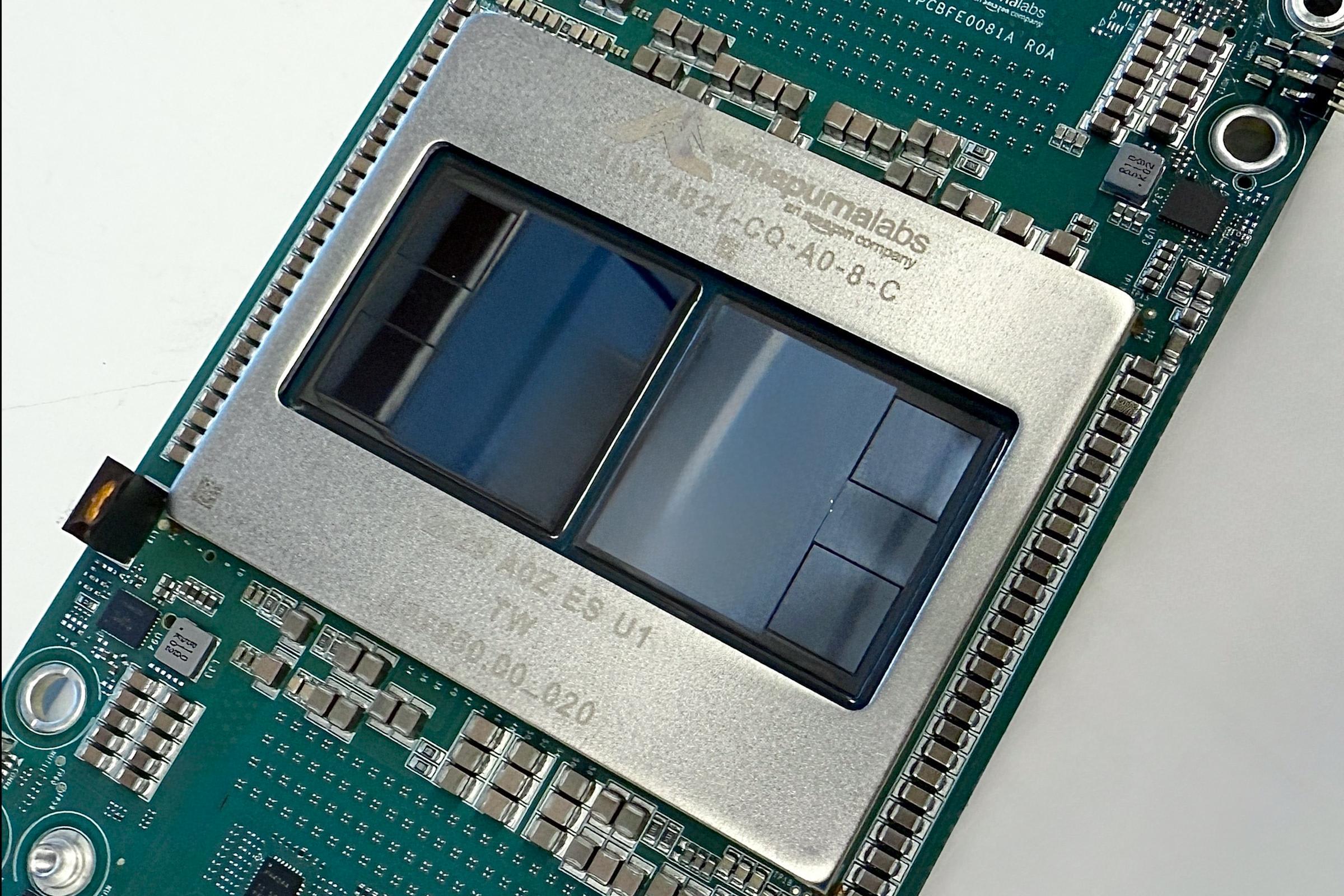
Amazon Web Services has developed its own AI processors under the Trainium brand. The chips are intended to offer customers alternatives to the powerful Nvidia graphics processors widely used throughout the industry.
However, many AI developers have spent years building applications around Nvidia's computing platform.
Changing hardware can require technical adjustments, software testing, and additional engineering work.
Even when competing processors offer attractive prices, these transition costs can discourage businesses from switching.
Decart's optimization technology could reduce some of that difficulty.
The company began working with Amazon in 2025, and the partnership has already produced encouraging performance results on Trainium hardware.
Amazon has previously said Decart achieved significantly faster real-time video processing on Trainium while reducing computing costs compared with the GPU configurations used in those tests.
Those results help explain the strategic value of the acquisition, although performance improvements may vary across different AI models and workloads.
The agreement also includes Decart's co-founders, Dean Leitersdorf, Moshe Shalev, and Orian Leitersdorf.
Their team brings experience in model optimization, machine learning, and high-performance computing.
Peter DeSantis, Amazon's senior vice president responsible for foundational AI models and custom silicon, said improving the efficiency of each chip is central to delivering more capable AI systems at lower costs.
Decart CEO Dean Leitersdorf also expressed support for joining Amazon, explaining that the company's infrastructure and customer reach could help accelerate the team's work.
The arrangement gives Amazon both the software and the engineering expertise behind it.
However, the announcement describes a purchase of Decart's proprietary optimization technology and the hiring of its team. It should not be confused with a confirmed acquisition of every Decart product or business asset.
Amazon has not publicly explained the future ownership or operation of all Decart's other products.
How the Decart Deal Could Strengthen Amazon Trainium Against Nvidia
The Amazon Decart acquisition comes as the cloud computing industry searches for ways to reduce its dependence on expensive AI infrastructure.
Nvidia remains a dominant supplier of processors used to train and operate advanced AI models. Its hardware is supported by a large software ecosystem, making it a familiar choice for developers and enterprises.
However, demand for AI computing has encouraged cloud providers to develop competing processors.
Amazon's Trainium chips are central to that effort.
The company already operates Trainium-powered systems inside AWS data centres, where customers can access computing capacity without purchasing physical chips themselves.
Amazon also plans to expand the availability of its custom processors beyond its existing cloud environment.
In October 2026, CEO Andy Jassy said the company intended to make Trainium available for use outside AWS in late 2027.
That plan creates a new challenge.
Selling computing capacity through a cloud service allows Amazon to manage much of the underlying infrastructure. Supporting customers who want to use its processors in other environments requires broader software compatibility and development tools.
Decart's expertise could help Amazon address those requirements.
If developers can run AI models efficiently on Trainium without rebuilding substantial parts of their applications, Amazon may have a stronger opportunity to win business from customers currently using Nvidia processors.
The economic argument is straightforward.
A business operating a large AI service may spend considerable amounts on computing power. Even modest improvements in processing speed or cost can produce meaningful savings when applied across millions of requests.
However, cheaper hardware alone may not persuade customers to switch.
Businesses also consider reliability, software support, availability, and how easily new processors integrate with existing systems.
Amazon's acquisition therefore addresses a software challenge as much as a hardware competition.
Decart has already demonstrated its optimization technology through demanding AI applications.
One example is Oasis 3, the interactive world model introduced in June 2026.
The system can generate photorealistic driving environments in real time, allowing simulated scenes to change in response to user actions.
Such technology has potential applications in autonomous vehicle development, robotics, and virtual simulations.
Decart has also developed AI video generation and transformation tools capable of processing visual information at high speeds.
These applications require efficient computing because they must deliver results with very little delay.
The same engineering principles can be applied to other demanding workloads, including language models and enterprise AI systems.
Amazon's interest in Decart also reflects an industry-wide competition to secure scarce engineering talent.
Building advanced processors is difficult, but developing the software needed to use them effectively can be equally challenging.
Companies with expertise in both areas have become attractive acquisition targets.
In May 2026, Decart raised $300 million in a funding round led by Radical Ventures, with Nvidia joining as an investor. The financing valued the startup at approximately $4 billion.
The reported Amazon transaction price would represent a substantial increase from that valuation.
However, the two figures are not directly equivalent. Decart's earlier valuation concerned the startup as a business, while Amazon's announced agreement focuses on specified technology and personnel.
The size of the reported deal nevertheless demonstrates how valuable AI infrastructure expertise has become.
For Amazon, success will depend on whether Decart's technology produces measurable improvements for customers using Trainium and other custom processors.
The company must also integrate the engineering team, maintain performance improvements, and continue developing tools that businesses can adopt easily.
Regulatory approval remains another requirement before the transaction can close.
As of November 23, 2026, Amazon has confirmed the agreement but has not announced a completion date.
The acquisition could strengthen AWS by making AI processing faster, cheaper, and easier to deploy across different computing environments.
It also highlights an important change in the AI industry. Competition is increasingly moving beyond the race to manufacture powerful chips towards the software that determines how efficiently those chips perform.
Amazon is betting that improving the technology behind AI computing will help its Trainium processors become a more compelling alternative to Nvidia's established platform.